Reflect: Art and History Gallery
The art and history gallery spotlights significant historical events related to campus sexual assault activism over the last 50 years alongside art by student survivors.
This exhibit contains depictions of gender-based violence, discrimination, and sexual assault. We acknowledge that this content may be activating for survivors and we encourage you to do what you need to take care of yourself. Confidential support, counseling, and resources are always available to you at no cost through University Health Services.
Passage of Title IX
1972
Title IX Passes
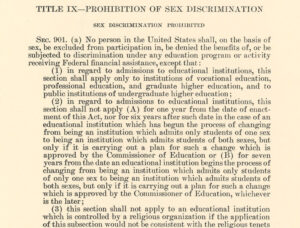
“No person in the United States shall, on the basis of sex, be excluded from participation in, be denied the benefits of, or be subjected to discrimination under any education program or activity receiving federal financial assistance.”
About Title IX
On June 23, President Nixon signed Title IX into law as part of the Education Amendment Act of 1972. Although Title IX eventually gained notoriety as a law mandating equal funding, access, and facilities in public sports–and became interchangeable with campus sexual assault–its origin stories stemmed from cases of faculty employment discrimination in academia.
Title IX is designed to protect individuals from discrimination based on sex in educational institutions that receive federal financial assistance. While Title IX is celebrated (and debated) today, it passed with little fanfare or national attention in 1972. At the time, the Education Amendments were far more controversial for its inclusion of anti-busing and segregation measures.
Who helped created Title IX?
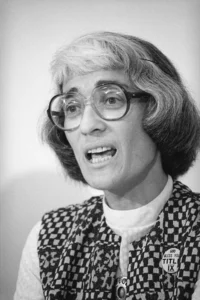
In 1969, Bernice “Bunny” Sandler was a soon-to-be doctoral graduate of the University of Maryland, who was job hunting for a postdoctoral or faculty position. After receiving the feedback “you come on too strong for a woman,” she began to research gender discrimination law. Upon discovering the existence of a 1968 Executive Order that prohibited sex discrimination by federal contractors (and making the connection that colleges receive federal contracts), Sandler used her this knowledge to file complaints against hundreds of campuses and mail letters to members of Congress, one of which caught the attention of Edith Green.

Representative Edith Green (D-OR), the “mother of Title IX,” was instrumental in leading the 1970 hearings that became the legislative foundation for Title IX. At the time of the hearings, there were just 11 women in Congress. All 15 members of the House Special Subcommittee on Education overseeing the hearings were men—seven of whom did not bother to attend the hearings. At the time, the most controversial point debated in the hearings was whether sex discrimination was a bigger problem in academia than race discrimination. Putting the plights of marginalized groups in competition with each other is still a commonly used political tactic of oppression used today.
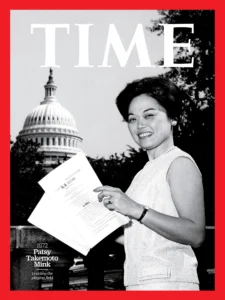
Representative Patsy T. Mink (D-HI), often honored as the author of Title IX, was also the first woman of color and Asian-American ever elected to the U.S. House of Representatives. Inspired by her own experiences of gender discrimination in her pursuit of a medical degree, Mink remained a fierce and lifelong advocate for equal opportunity in education for her entire career.
“Millions of women pay taxes into the federal treasury and we collectively resent that these funds should be used for the support of institutions to which we are denied equal access.”
Pushback and New Precedents
1980s
Challenges to Title IX
Dozens of court cases and congressional bills attempted to challenge Title IX. These challenges strengthened the legal precedent for Title IX protections.
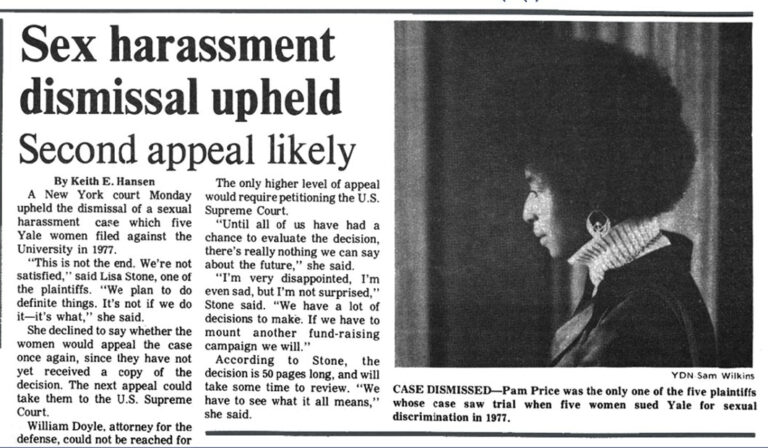
This was the first case to demonstrate that Title IX protections apply to sexual harassment. The case was originally named for Ronni Alexander—a Yale sophomore who reported being raped by the university’s band leader, who had been accused of rape and sexual harassment by other students. Pamela Price was asked to join the case with Alexander and three other complainants to establish a pattern of unchecked sexual harassment at Yale. Price reported being sexually propositioned by a professor who proposed he would give her an A in exchange for sex. She refused and the professor graded her a C. Price filed a written complaint with a university dean. At the time, there was no established grievance procedure, and nothing came of Price’s complaint.
A district court affirmed that Title IX could indeed apply to sexual harassment but dismissed the four other parties on technicalities. The case proceeded with Price as the lone plaintiff. For Price and many watching, it felt like a decision pitting a Black woman student against a white male professor and white institution.
Price lost the trial and appeal, but the precedent sent a chilling warning to universities around the country. Soon, many major universities, including the UW-Madison, adopted formal sex discrimination policies and grievance procedures.
Decided in the Massachusetts Supreme Judicial Court, Mullins v. Pine Manor clarified campuses’ role in protecting student safety. In 1977, student Lisa Mullins was abducted from her campus dorm room, dragged across campus with a pillowcase over her head, and raped in the campus dining hall. Mullins brought charges against the university, arguing that both the campus requirement to live in university housing and the faulty security measures in place made them liable for the attack. The university argued that they had no duty to protect its students against criminal acts of third parties. The court sided with Mullins and the case captured public attention, laying the groundwork for legislation on campus safety that defines college life today.
In 1976, the president of Grove City College, a private, Christian college, refused to participate in the Department of Education’s assurance of compliance procedures for Title IX regulations. Grove City argued that, because they did not receive federal funding, a key parameter of Title IX, they did not need to comply with the law. The Supreme Court clarified that, even if a university itself does not receive government assistance, the flow of financial aid from the Department of Education through student loans does constitute federal funding and that the college either needed to comply or stop accepting federal student loans.
Laying the Legal Precedent
1990s
Clery Act and other key legislation
Today, expectations for American universities to prevent and respond to campus sexual violence are largely shaped by the legislative relationship between the Title IX, the Clery Act, and VAWA.

Jeanne Clery Disclosure of Campus Security Policy and Campus Crime Statistics Act (known as the Clery Act) was passed by Congress in 1990. The Clery Act requires colleges and universities to keep and disclose up-to-date logs of crimes that take place on campus property. The statute was named to honor Jeanne Clery, a student at Lehigh University who was raped and murdered in her dorm by another student in 1986. Jeanne’s parents were convinced that the university could and should have done more to prevent this tragedy and became tireless advocates for change, influencing the eventual passage of the law.
Today, college students receive timely crime warnings and the Annual Security and Fire Safety Report that share information about campus crimes—both are legacy of the Clery Act.
Christine Franklin was a high school student at North Gwinnett High School in Georgia who was the target of ongoing sexual harassment and abuse from Andrew Hill, a coach and educator employed in her school district. The school administration was made aware of the behavior, did nothing, and discouraged Franklin from pursuing charges. Franklin sued the school district for personal injury, demonstrating years of sexually explicit comments, forced kissing, and coerced intercourse on school grounds from the teacher. For the first time, the Supreme Court ruled that monetary damages are available under Title IX. The court’s decision was unanimous. Previously, the only justice available was the hope that the Department of Education Office of Civil Rights would complete an investigation, determine that the school violated Title IX, and issue a citation requesting they do better.
Democratic House representatives introduced the Violence Against Women Act in 1991 (VAWA). VAWA was signed into law by President Clinton, and was the largest federal effort to address gender-based violence. VAWA established the first national domestic violence hotline and changed law enforcement policies for arresting and prosecuting domestic violence offenders. In a 2012 report, the U.S. Department of Justice estimated that national rates of intimate partner violence fell 64 percent between VAWA’s passage and 2010.
Today, expectations for American universities to prevent and respond to campus sexual violence are largely shaped by the legislative relationship between the Title IX, the Clery Act, and VAWA.
Survivor Activism at UW-Madison
2008
Laura Dunn graduates
A survivor advocate at UW-Madison, Laura Dunn shaped both local and national legislation.

“It was late, I wanted to be safe. I had no reason not to trust them. I thought rape was a stranger jumping out of an alley attacking you with a knife. I didn’t have any narrative where it’s someone I knew.”
Laura Dunn, a UW-Madison student athlete, was sexually assaulted while incapacitated from alcohol during her freshman year by members of the men’s rowing team who walked her home. Dunn reported the assault to the Dean of Students Office and the UW Police Department one year later, by which point one of the assailants had graduated. The university concluded its investigation the following year, finding the men not responsible; the District Attorney’s office also declined to press charges. At the time, Wisconsin law did not consider alcohol a legal intoxicant capable of altering the ability to consent in rape cases.
Common for sexual assault survivors, Dunn managed safety measures and retaliation on her own. She dropped her sport to avoid seeing the attacker who remained on campus and cut ties with mutual friends who did not want to get involved. Dissatisfied by how the university handled her disclosure and case, she became one of the first students to file a Title IX complaint against a large, public university. In 2008, after Dunn graduated, the Office of Civil Rights (OCR) ruled in UW-Madison’s favor and found that the university was not responsible for violating Dunn’s Title IX rights.
Motivated by the injustice she faced, Laura earned a law degree and became involved with federal campus sexual assault legislation. She served on the 2014 rule-making committee to shape the regulations of the Campus SaVE Act.
Clarification in Congress
2010s
Clarification in Congress
“The sexual harassment of students, including sexual violence, interferes with students’ right to receive an education free from discrimination…”

In 2011, under the Obama administration, the Department of Education’s Office of Civil Rights (OCR) released an important “Dear Colleague Letter” to Congress, which included important guidance on Title IX. The letter clarified that sexual violence—including sexual assault, rape, and sexual coercion—is not only a crime, but constitutes discrimination. The letter and subsequent guidance explicitly outlined universities’ obligations to both respond to and take meaningful steps to prevent sexual harassment and violence. This put universities on official notice that the Office of Civil Rights would pay closer attention to how schools’ handle sexual assault cases and established that the preponderance of the evidence standard (i.e., it is more likely than not that sexual harassment or violence occurred) is most appropriate for investigating allegations.
Over the next five years, the OCR issued more Dear Colleague letters providing guidance on students’ civil rights related to gender discrimination, including rights of pregnant (2013) and transgender students (2016).
As part of the VAWA Reauthorization Act of 2013, the Clery Act was amended with a series of changes referred to as the Campus Sexual Violence Elimination Act (Campus SaVE Act). The Campus SaVE Act expanded Clery reporting and transparency requirements to include disclosing statistics on dating violence, domestic violence, sexual assault, and stalking. It expanded victim rights, accommodations, and protective measures to survivors, regardless of whether they choose to report to law enforcement. Colleges also became required to provide education and awareness programs to its students, which is why most campuses to this now require some sort of sexual violence education program during orientation.
Activism and Attention
2010s
A movement decades in the making
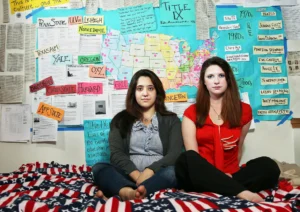
Andrea Pino and Annie Clark, were two student survivors attending the University of North Carolina at Chapel Hill. While the sexual assaults they experienced were very different—Clark was attacked by a stranger and Pino raped in a bathroom at an off-campus party—their shared experience of being dismissed and discouraged by the university upon reporting was similar.
The women learned everything they could about campus sexual assault legislation on their own and filed a 34-page complaint to OCR against UNC. They traveled the country assisting other student survivors in filing suits, marking their progress on a map of the U.S. When the Department of Education released the list of 55 universities under Title IX investigation, the list nearly matched Pino’s and Clark’s map. Their cases and advocacy work brought national attention, including the front page of the New York Times.

Frustrated and motivated by how they each had to piece information about rights and resources together for their own sexual assault cases, Amherst College student Dana Bolger and Yale Law School student Alexandra Brodsky created the Know Your IX website. What was initially thought of as a short-term project to host crowd-sourced resources for legal action, campus organizing, and self-care blossomed into a comprehensive web resource for students across the country seeking information about complaint filing procedures and statutory requirements.
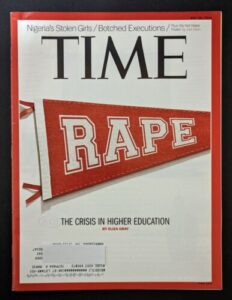
Campus sexual assault became a matter of public discourse outside of higher education circles. Time magazine, the New York Times, and Rolling Stone all ran cover stories on the topic between 2013 and 2014. The Rolling Stone story was later retracted for faulty reporting.
“The truth is, for young women, particularly those who are 18 or 19 years old, just beginning their college experience, America’s campuses are hazardous places.”

In 2014, Columbia University art student Emma Sulkowicz made national news with their endurance art piece titled, “Mattress Performance (Carry That Weight).” The senior thesis performance involved Sulkowicz carrying a 50-pound mattress across campus to represent the dorm bed they reported they were raped on. Sulkowicz vowed to carry the mattress until the named attacker was expelled or graduation, whichever came first. The accused party was found not responsible, and Sulkowicz carried their mattress, assisted by fellow students, across the graduation stage. In solidarity with Sulkowicz’s cause, many mattress-carrying protests took place at other campuses.

In 2015, the documentary film The Hunting Ground premiered and highlighted the problem of campus sexual assault and systematic failures of college administrations to address the issue.
Kamilah Willingham, a survivor activist featured in the film, reported that she and a friend had been sexually assaulted by a fellow Harvard University student in 2011. An independent attorney hired by Harvard to conduct the investigation initially found the case credible, and recommended expulsion. When the accused student appealed, a panel of Harvard Law faculty overturned the original findings, using a standard of evidence that would eventually be considered a violation of Title IX. Willingham faced public backlash from her alma mater after appearing in The Hunting Ground. A group of 19 Harvard professors issued a press release and penned an open letter disputing Willingham’s claim and offering support for her assailant.
The Hunting Ground was met with critical acclaim and was nominated for an Academy Award and won an Emmy.
UW-Madison’s History
1990s – Today
Sexual violence prevention on campus
University Health Services hired its first prevention coordinator to work on issues of campus-based violence.
2001: UW-Madison student Angela Rose forms PAVE (Promoting Awareness, Student Empowerment). Today, PAVE is a national organization with chapters all around the country. At UW-Madison, PAVE maintains an operational budget of around $80,000.
2007: University Health Services is awarded a Victims of Crime Act (VOCA) grant to expand efforts to coordinate campus-based services.
2008: Laura Dunn graduates and the Office of Civil Rights finds UW-Madison not responsible for violating her Title IX rights.
2010: UW-Madison conducts its first comprehensive student needs assessment identifying dating violence survivors as an underserved population.
2013: In anticipation of new regulatory guidance, UW-Madison begins requiring interpersonal violence education for first-year students rather than encouraging it. Similar requirements for graduate students and employees follow soon after.
2014: The Violence Prevention and Survivor Services office expands from one to three full-time staff.
2015: The first AAU Campus Climate Survey is administered to UW-Madison students, with results released in the following year. Among other key findings, the survey revealed that more than one in four undergraduate women reported experiencing sexual assault during their time on campus. The survey also found concerning rates of sexual harassment reported by graduate student from faculty, staff, and administrators.
2016: UW-Madison hires its first full-time Title IX Coordinator. Three additional full-time positions are added to Violence Prevention and Survivor Services, totaling a team of seven.
Sexual violence prevention and response was identified as one of the eight strategic key initiatives within the Student Affairs strategic plan. This initiative aims to create and support cross-campus systems for coordinated sexual assault response with a focus on prevention, increasing access to care and building a trauma informed campus.
The Sexual Assault Prevention and Community Equity Toolkit (SPACE Toolkit) taskforce was created.
Audio Stories From Our Campus Community
Coalition Building
Listen to ASM’s Anti-Violence Chair Landis Varughese speak about the role that was created to serve as a liaison between students and campus decision-makers around sexual violence prevention.
Strategic Initiatives
Listen to Molly Caradonna, Director of UHS Survivor Services, talk about current and future strategic initiatives to prevent sexual assault on campus.
Student Activism
Listen to former PAVE Chair Eli Tsarovsky discuss the importance of activism and community care.
Student Organizations
Listen to PAVE peer facilitator Spencer Runde discuss PAVE’s history and current work on campus.
Continued Learning
Listen to Prisma Ruacho from the Multicultural Student Center reflect on how continued learning around sexual violence has inspired her work.
Community Resources
Listen to Morgan Reed, a Youth Violence Prevention Advocate at DAIS (Domestic Abuse Intervention Services), talk about the resources and support DAIS can provide for UW–Madison students and others in the community.
Looking Ahead
2024 and Beyond
Future Direction
What comes next?
After 50 years, Title IX has changed the landscape of the American education system, athletics, and civil rights. What was originally conceived as an employment discrimination law later became known to the public as a gender parity in sports law, then a campus sexual assault law. Since its implementation in the 1970s, women’s participation in high school sports has grown from fewer than 300,000 to more than 3.5 million students.
Today, the specifics of Title IX regulations fluctuate with each presidential administration, including guidance around regulations concerning transgender and pregnant students.
History has often witnessed legislation dividing identity groups, often out of political strategy to advance change. In fact, Rep. Edith’s Green’s first draft of Title IX borrowed language directly from Title VI of the Civil Rights Act, replacing “race” with “sex,” not adding to it.
This strategy means that students who face discrimination based on multiple, intersecting identities are left to navigate several offices and varying procedures. Creating greater cohesion in civil rights across protected statuses like sex, gender, orientation, race, color, national origin, and ability has the potential to expand education protections for all students.
Even as regulations change and evolve, UW–Madison is looking to the future of sexual violence prevention and response.
In 2024, two campus groups were convened to address gaps in campus coordination: a sexual assault response team and a community of practice. Having listened to survivors on unsatisfying outcomes and a failure to meet their needs through formal justice and conduct procedures, campus decision-makers are exploring restorative/transformative justice options available to student survivors.