Safe Medication Storage and Disposal
Safe medication storage and disposal helps keep our campus community safe by:
- Protecting the environment: Improperly disposing of expired or unwanted medications, such as by flushing them down the toilet or placing them in general trash collection, can cause contamination of groundwater and poison people, pets, and wildlife.
- Preventing misuse, overdose, and other harm: Securing medications in shared living spaces ensures that prescription medications are not taken by those who are not prescribed those medications. This is especially important for controlled medications, like opioids or stimulants.
- Restricting lethal means: Restricting access to potentially harmful medications reduces the risk for suicide and accidental overdose by vulnerable individuals and those in crisis.
On this page
Medication storage
Medication storage best practices
- Keep medications in the original bottle, with the label attached and the child-resistant cap secured.
- Place medications in a safe, secure place where roommates, children, guests, family, and pets can’t access them.
- Never share prescription medications.
- If taking a controlled medication or prescription pain medications, like opioids, make sure these medications are locked in a medication lockbox, cabinet, or drawer.
- When using a lockbox, share the combination with a family member or friend who does not live with you. You can contact this person to receive the combination if you forget it.
- Regularly check for medications you no longer use or that are past their expiration date and safely dispose of them.
What medications should be locked up?
Lock up medications that can be dangerous if misused or when taken not as prescribed, such as:
- Prescription medications
- Opioids
- Stimulants
What medications should NOT be locked up?
Do not place medications that may need to be accessed quickly in a lockbox. Examples include:
- Inhalers
- Epi pens
- Narcan
- Insulin
- First-aid supplies
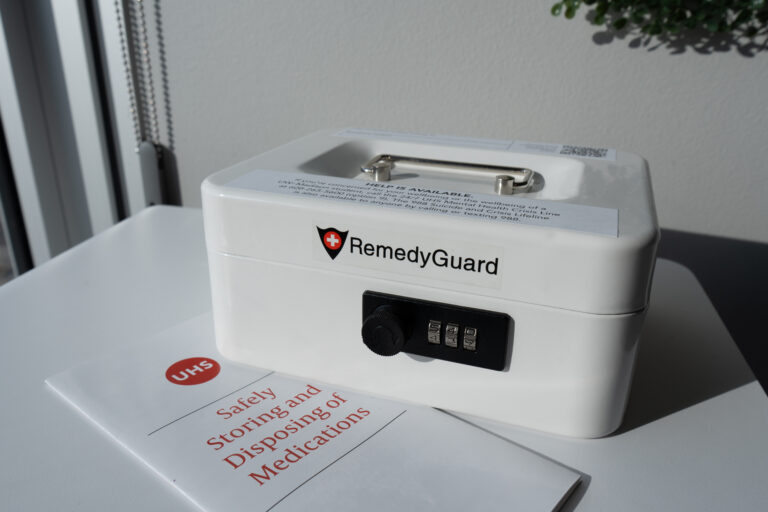
UHS Medication Lockbox Program
Because students often live with others and are potentially managing their health care for the first time, it is important that they take proper steps to secure their medications.
To support safe medication storage on campus, UHS provides medication lockboxes to students upon request. Medication lockboxes are helpful for students who are prescribed medications and/or students who have concerns about misuse, overdose, or self-injury.
Medication lockboxes are available at UHS. If you are interested in receiving a lockbox, please visit the UHS front desk during regular hours. There are no requirements to receive a lockbox through the Medication Lockbox Program, except that you are a student at UW–Madison. To receive a lockbox, you will be asked to complete a brief form to confirm your participation in the program.
Free medication lockbox are also available in the Madison area through Safe Communities.
Yes, all UW–Madison students are eligible to receive a medication lockbox from UHS, regardless of whether they are a current UHS patient.
Yes! The medication lockboxes are provided at no cost to UW-Madison students.
Medication disposal
If you have prescription or over-the-counter medications that are expired or that you no longer need, make a plan to dispose of these items safely. Here are a few simple ways you can safely dispose of medications to help keep your community safe.
- Pills, liquids, creams, powders, and patches (both prescriptions and over-the-counter medications)
- Inhalers and nebulizer solution
- Vitamins
- Medications for pets
Medication drop boxes
Dispose of medications at designated medication drop boxes and collection sites on campus and in the Madison community.
- On campus. The University of Wisconsin Police Department offers a medication drop box that’s available 24 hours a day, 7 days a week at 1429 Monroe St.
- At a pharmacy. Many pharmacies also host drop box locations. Find one near you.
- In the Madison community: Safe Communities offers the Med Drop program. Drug collection sites are also located at many fire stations, hospitals, and municipal buildings.
- Other locations: The Drug Enforcement Agency offers an online tool for finding a designated collection site near you.
- Sharps, including needles, Epi-pens, or anything with a lancet. These items should not be placed in trash or recycling and can be disposed of in a designated sharps disposal container.
- Vapes. Vape batteries must be disposed of at a designated disposal program, such as Dane County Clean Sweep. Vape liquids (full or used pods) can be disposed of at drug take-back locations.
- Medical equipment, such as nebulizer machines, oxygen tanks, and IV bags are not permitted.
The Drug Enforcement Agency (DEA) offers medication take-back events throughout the year. Drug take-back events periodically take place on campus in partnership between University Health Services, UWPD, and local public health agencies.
Other safe disposal options
While medication disposal at a drop box or take-back event is preferred, these options can be used if preferred disposal options are not readily available:
- Use a drug deactivation bag to safely dissolve and dispose of medication. Free at-home medication disposal kits are available in Madison through Safe Communities.
- Safely dispose of the medication at home according to FDA instructions.